




Our radio station Señal Radio Colombia celebrates its 75 years on air
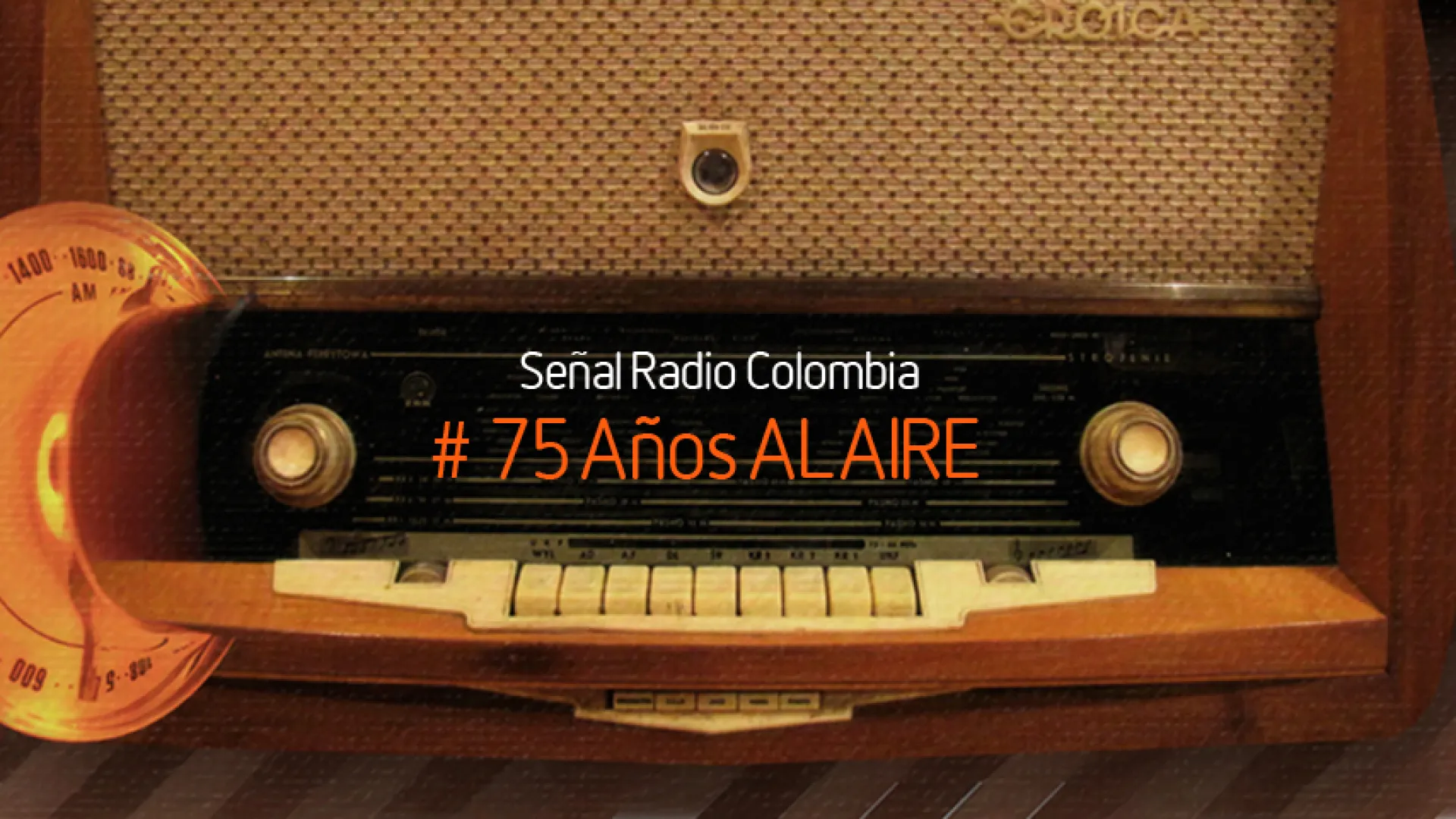
Our radio station Señal Radio Colombia completes 75 years of service to the Colombian people. In order to celebrate this important event, starting next Monday, February the 2nd Señal Radio Colombia will operate two decentralized stations, one in Bucaramanga which can be tuned at 92.3 FM frequency and the other one in Manizales at 92.7 FM frequency. These stations will broadcast local newscast seeking to contribute to the decentralization of the public radio in Colombia.
The origins of what is now Señal Radio Colombia -the public radio- date back to the year 1940 and particularly, the 1st February of that year when the National Radiobroadcaster of Colombia was founded by the then President, Eduardo Santos. On the occasion of the 75 years of our station, we want you to know the history that is told through the archives held by Señal Memoria in the article presented below:
"...that the body of Jorge Eliecer Gaitán will be embalmed and that will continue as a symbol of this movement, for so it will be buried once the conservative party is buried, which has already reached its decline".
Overwhelming statements. Were pronounced by Gerardo Molina on April 9th 1948, Chairman of the Executive Committee of the Revolutionary Central Board of the Government, through the National Radiobroadcaster of Colombia. After the assassination of Jorge Eliecer Gaitán, Liberal riots took over the station and tried, through it, to organize forces for a seizure of power.
The old sound has a charm to transport the listener over time. There are historical references from the events, but also about the technological development of the recording. Both aspects are the pillars to think about the history of radio. Señal Memoria keeps the sound prints that the Colombian National Radiobroadcaster left behind, which became later Broadcaster that others named National Radio or simply “The Radiobroadcaster”, which was later divided into "Clásica", "Joven" and "A.M.", and that today is called Señal Radio Colombia and its sister station Señal Radiónica. The story has reached 75 years.
Entertainment and diverse information were, as today, the objectives of the station since its foundation on the first of February 1940. But also, a fundamental purpose was the education. Increase the cultural level of the country in accordance to the ideals of the time. This task was entrusted to influential intellectuals who carried out numerous programs principally on music, literature and history. In its set, these and other preserved recordings show us nowadays the interests that existed and the way they were developed.
Classical Music had more space had in programming. Otto and León de Greiff had a very important role because, at first, the Radiobroadcaster was not provided with a record library. Then the Greiff brothers placed at the disposal of the broadcasting station their personal record collection and were in charge of realizing several programs.
There was classical music of all kinds in the broadcasting station: orchestral, camera, soloists, opera, etc. But, the Colombian popular music was also present. From the decade of 1940 in the programming the “Conjunto Típico Luis A. Calvo y sus cantantes” can be found. It is not known exactly which repertoires were they playing but apparently the broadcasting station emphasized on the instrumental Andean music. And the fact is that perhaps that was the one that approached the most to the ideals of “high culture” that were characterizing the broadcasting station. "Mundane" topics, on which the song texts have been based for ages, had little of highness.
Nevertheless, on the fifties the Radiobroadcaster was presenting programs with the Oriol Rangel set and also with the Hermanas Garavito. It was a decade in which very important events on national history occurred. The main marks were left by Gustavo Rojas Pinilla, one of the Colombian leaders who had major conscience of the power of mass media, who in June 14th 953 came to the power after a military coup.
After the interval of the military governments (Rojas Pinilla and the Military Board), which governed from 1953 until 1958, Colombia stepped forward to the National Front. It began with the liberal government of Alberto Lleras Camargo, Colombian politician with wide experience in international affairs, what undoubtedly marked the guidelines of its commandment.
One of the main topics in the government agenda from the National Front governments was the conflict for the land. Both Lleras, Alberto and Carlos, were interested about settling a Land reform. The conservative government of Misael Pastrana (1970-74), which was the ended the interval, had other guidelines. In this background two decisive situations appeared in the national history: emergence and consolidation of guerrilla groups and establishment of the Caribbean music in the national taste.
The latter aspect depended, in one hand, on the favourable will of governments like the one of Guillermo León Valencia (1962-66) (who had for the first time a vallenato group in the Presidential Palace), or the one of Alfonso López Michelsen (1974-78), who was the first governor of the department of Cesar, created in 1967, and who founded the following year the Festival de la Leyenda Vallenata. On the other hand, there was the complementary role of the record industry and the mass media as well as the influence of intellectuals with widespread recognition and capacity of management. For example, the Radiobroadcaster had the presence of brothers Delia and Manuel Zapata Olivella.
In addition to the programs performed for the broadcasting station on the afro-descendent culture, Manuel Zapata took part as a guest in other sections such as the one dedicated to literature: "De viva Voz”. Señal Memoria preserves the lecture from the writer, of some new paragraphs of its novel “El fusilamiento del Diablo”. . The work reflects and treats some aspects of the conflict generated with “La guerra de los mil días”: birth of guerrillas, foreign presence on the economy of the country, social and racial inequity, and in a particular way, talks about death penalty in Colombia whose last victim, in 1907, was the intellectual from Chocó Manuel Saturio Valencia, protagonist of the novel.
As soon as it was possible to mobilize equipment and to record in distant places, the Radiobroadcaster also began broadcasting folk festivals created until then. A work that tied very well with the consolidation of a unified national feeling, intention that took the whole XX century. The most ancient recordings from festivals done by the National Radiobroadcaster are from the year 1977. There is the tenth edition of the Festival de la Leyenda Vallenata, in which Juancho Polo Valencia participated.
Thus, diverse cultural expressions of the Caribbean gained terrain. In a wider perspective, we should not forget, for example, an influential program in the eighties, as it was “Dejémonos de vainas”. Next to “Josefa“, the cundi-boyacense farmer, one of the most attractive characters there, was “El Costeño”. But a definitive event that crowns the decade was the Nobel Prize of literature granted to Gabriel García Márquez for “Cien años de soledad”, his 400 pages vallenato.
Since the eighties, the vallenato found a section in the Radiobroadcaster programming with “Estampas vallenatas” Already
In the fifties, as it was mentioned a section dedicated to the Colombian music was programmed, this was carried out by the musicologist Andrés Pardo Tovar (1911-72). Guillermo Abadía Morales (1912-2010) was also there from a very early date. But both always kept a diverse character, with an inclination towards Andean and Caribbean music, favoured by the record industry. Until the eighties, no genre had reached this particularity of an exclusive program as it did for vallenato. Nevertheless, with the nineties, it came round a multicultural vision of the country that gave capacity to a bigger presence of the diversity that characterizes the nation.
The Constitution of 91 defined new orientations in the cultural policies of the country and in the state mass media. In the National Radio the emphasis given to the classical music continued, coherent music with half a century of history. But as for the popular declarations, it was no longer a question of the poles between the Andean and Caribbean music. An illustrative example, which bring together the the tradition from work made decades behind with the forthcoming works in the XXI century, is the sonorous testimony that survives with the presence that the Radiobroadcaster had from the very first edition of the Festival de Música del Pacífico “Petronio Álvarez” in 1997.
On this base, Señal Radio Colombia enters in the XXI century with the target to be consolidated as an innovative option opposite to the national radial offer. Its interest in the new Colombian music pieces and music from other parts of the world, in dialogue with widespread accepted genres; a reflective point of view on the present of the country and the world; the development of multimedia contents to be offered on the web, are components of first order for a contemporary proposal that is reflected in the increase in the number of listeners.